The New Standard in Heart Prevention
Why Cardisiography? Until now, simple heart screening has been difficult or required significant effort. Cardisiography is the first preventive examination that uses artificial intelligence to reliably detect heart diseases. It enables an effective heart checkup – simple, fast, and precise. An ECG or stress ECG provides only limited information when it comes to detecting circulatory disorders in the heart muscle. Cardisiography, on the other hand, delivers results within just a few minutes and with very high accuracy*, showing whether your heart is healthy.
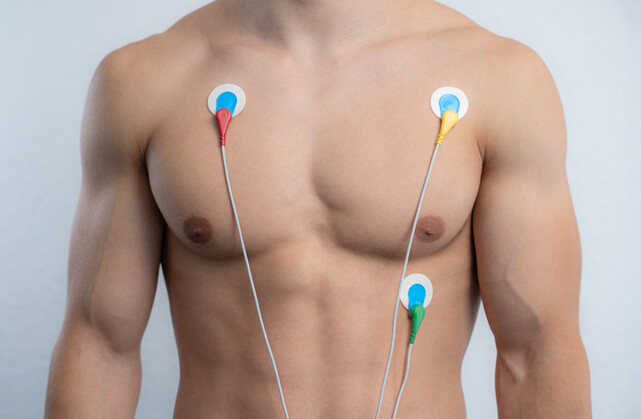
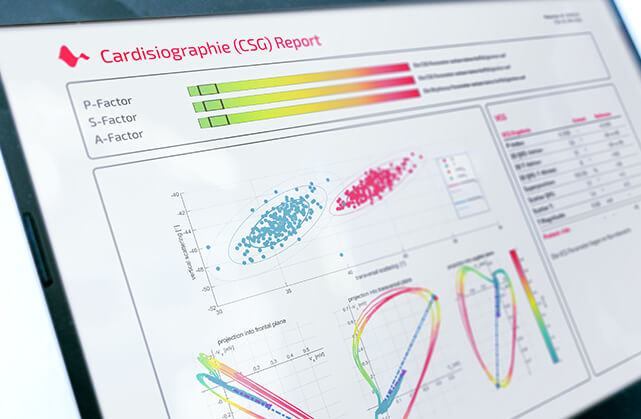
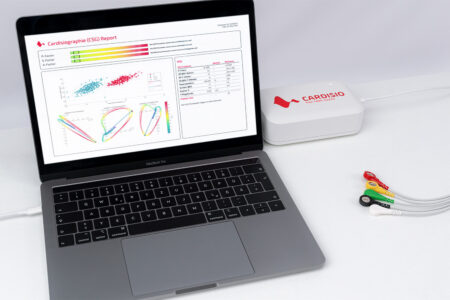 Cardisiography is as easy to perform as a standard ECG, but it measures the heart muscle in three-dimensional space. The recorded data is analyzed by a specialized computer algorithm based on artificial intelligence. The evaluation quickly provides clarity on whether the heart shows signs of disease or if there may be a risk of a heart attack. A Cardisiography is non-invasive, meaning that only electrodes are placed on the body – no needles or injections are used. This makes the procedure completely risk-free and suitable for all adults, regardless of age or health condition. Most people at risk show no symptoms until they suffer a heart attack, or they are only diagnosed once severe symptoms appear. Cardisiography makes it possible for anyone to assess their heart attack risk – allowing you to keep track of your heart health easily and effortlessly.
Great importance is also placed on data protection: only information necessary for the examination is collected, such as age and weight. Other personal details, like your name or address, are not entered and remain with your doctor.
It’s important to know that an abnormal Cardisiography result does not automatically indicate an acute emergency. At this stage, potential problems can still be actively prevented. If a Cardisiography screening detects possible heart issues, your doctor will provide you with detailed information and next steps. Early detection can help prevent serious consequences, and patients are usually referred for further examinations, such as a cardiac MRI, which often quickly reveals the cause of the condition.
With timely diagnosis and appropriate treatment, for example medication or a minor procedure, serious outcomes like a heart attack can be avoided.
Cardisiography serves as a valuable decision-making tool for doctors during the early diagnostic phase, enabling the right therapeutic path to be chosen as soon as possible. That is why early heart screening is so important.
*Braun T, Spiliopoulos S, Veltman C, Hergesell V, Passow A, Tenderich G, Borggrefe M, Koerner MM. Detection of myocardial ischemia due to clinically asymptomatic coronary artery stenosis at rest using supervised artificial intelligence-enabled vectorcardiography – A five-fold cross validation of accuracy. J Electrocardiol. 2020 Mar-Apr;59:100-105. doi: 10.1016/j.jelectrocard.2019.12.018. Epub 2020 Jan 8. PMID: 32036110.